Date & Time
30 September 2026, 15:45 – 17:15
Room
Galapagos
Chaired by
Hee-Dae Kim
Director General, Daegu Technopark
Hee-Dae Kim
Director General, Daegu TechnoparkHee-Dae Kim holds a Ph.D. in Technology and Business Management from KAIST and serves as Director General at Daegu Technopark, South Korea. He is also the Project Director of the Korea Smart City Specialized Complex Development in Daegu and Chief Secretariat of Daegu Creative Living Lab (D-Lab), a member of ENoLL. His work focuses on designing innovation ecosystems that connect technology, cities, and citizens through living labs, digital transformation, and AI-enabled urban innovation. He developed the Smart Communication Platform methodology to strengthen citizen participation in urban governance and has led numerous smart city initiatives since 2016. An active member of ENoLL since 2019, he has served as an evaluator for ENoLL research activities and chaired the Living Labs for Business and Emerging Technologies research track at OpenLivingLab Days 2025. He has authored several books and published extensively on smart cities, living labs, and digital innovation.
Type of Session
Research Session
Description
Following a rigorous evaluation process, the OLLD26 evaluation committee has accepted the research papers for this year’s conference. All accepted papers engage with the conference theme, “Living Labs Impacts and Values for a Changing World,” and have been classified into five sub-tracks:
- Track 1: Living Labs for Grand Societal Challenges
- Track 2: Living Labs for Policies, Governance, Collaboration, and Innovation Ecosystems
- Track 3: Living Labs for Inclusive Soci(et)al Engagement
- Track 4: Living Labs for Business and Emerging Technology
- Track 5: Living Labs Operations, Methods, Tools, and Impact
Papers selected by the Evaluation Committee
- Human-led and AI-led customer journey mapping as complementary knowledge production in a Living Lab
- Scaling energy system integration via a three-Level Living Lab pathway
- Identifying "Recipes" for successful implementation: A comparative fsQCA of technology acceptance determinants in healthcare Living Labs
- The GEM BizLab as a learning lab for technology and innovation management
- From Testbed to Co-Investor: Repositioning Living Labs in Relation to the Business Sector
- From consultation to co-Creation: A rural Living Lab model for community revitalization in demographically declining municipalities
Human-led and AI-led customer journey mapping as complementary knowledge production in a Living Lab
Abstract:
Customer journey mapping (CJM) has fragmented into heterogeneous modelling practices, yet the epistemic consequences of that fragmentation remain poorly understood: it is unclear what each modelling logic makes visible and what it leaves out.
This paper addresses that gap through a Design Science Research (DSR)–based Living Lab case study in a B2B membership organization, comparing two customer journey artefacts built on the same journey structure: a human‑led, co‑created journey and an AI‑led journey derived from 2,379 customer comments. The two artefacts do not offer alternative pictures of the same experience; they produce different forms of emotional knowledge. The human‑led artefact makes felt emotion visible: lived, situated experience articulated through narrative, meaning and identity. The AI‑led artefact surfaces evaluative emotion: cumulative, judgement‑based assessments of trust, fairness, tolerance and value for money that govern continuation or exit.
The article therefore repositions customer journey mapping as comparative emotional knowledge production rather than the pursuit of a single accurate customer journey. For Living Lab research, it shows that human‑led co‑creation and AI‑led synthesis are complementary participation logics, and that reading the two artefacts against each other is what renders an organization’s own assumptions about its customers visible and contestable.
Sirpa Toljander
Customer Experience Director, Dagmar
Sirpa Toljander
Customer Experience Director, DagmarSirpa Toljander is Customer Experience Director at Dagmar and a doctoral researcher specializing in customer experience management, participatory design methods, and design thinking. Her research and professional work examine how organizations can create business value through deeper customer understanding, human-centered innovation, and evidence-based development. She is particularly interested in the interplay between customers, organizations, and emerging technologies, exploring how artificial intelligence, co-creation, and design-driven approaches can enhance customer experiences, organizational capabilities, and business outcomes.
Scaling energy system integration via a three-Level Living Lab pathway
Abstract:
To reduce the European Union’s dependence on fossil fuels and diversify its energy supply before 2030, the REFORMERS project addresses the main problem of accelerating the transition to decentralised, integrated energy systems. The project advances the concept of Renewable Energy Valleys (REVs): systems with high shares of renewable generation, storage technologies, and intelligent management algorithms. By enabling the synergistic operation of multiple technologies and energy carriers, REVs can become self-sufficient annually and provide a promising pathway towards a more resilient and sustainable European energy system.
A key enabling technology is the digital twin, which supports the analysis, planning, optimisation, and control of renewable and multi-energy assets. Within REFORMERS, these solutions are not only developed and implemented in real-life settings but are also systematically scaled to support wider deployment across Europe.
Arnoud van der Zee
Program Manager for Future Energy Systems, Delft University of Technology (TU Delft)
Arnoud van der Zee
Program Manager for Future Energy Systems, Delft University of Technology (TU Delft)Arnoud van der Zee is Program Manager for Future Energy Systems at Delft University of Technology (TU Delft) and one of the directors of Fieldlab The Green Village. This fieldlab enables and supports companies and researchers in testing their sustainable solutions. The fieldlab has truly unique facilities, consisting of 10 buildings, utility and residential, and any energy system you can think of. The look and feel is that of a real neighbourhood which streets, squares and buildings and 13 inhabitants living on side. The fieldlab works closely together with the water, energy and building sector. His work focuses on connecting researchers, industry partners, governments, and societal stakeholders to address the challenges of the energy transition. Arnoud is actively involved in building national and international partnerships, fostering interdisciplinary innovation, and translating research into real-world impact. With a strong interest in emerging technologies, living labs, and ecosystem development, he supports initiatives that contribute to a more flexible, integrated, and future-proof energy infrastructure. Through his collaborative approach, Arnoud aims to bridge science, policy, and practice to enable a successful transition towards a carbon-neutral energy system.
Identifying "Recipes" for successful implementation: A comparative fsQCA of technology acceptance determinants in healthcare Living Labs
Abstract:
Living Labs (LLs) are increasingly deployed in healthcare contexts to support the development and real‑world testing of emerging technologies, yet empirical evidence on how specific LL conditions drive implementation success remains limited (Chaudoir et al., 2013). Building on the implementation‑oriented LL framework proposed by Zipfel et al. (2022), this research‑in‑progress paper investigates how assemblages of LL attributes contribute to early implementation success in healthcare technology pilots by examining six medical LLs conducted during the piloting of new technologies across different healthcare organisations.
The attributes in the hypothesised model (openness, involvement, leadership, timing, organisational support, and ownership) are operationalised as determinants and measured using validated questionnaires. Fuzzy‑set Qualitative Comparative Analysis (fsQCA) is applied to identify configurations of conditions associated with changes in Technology Acceptance Model (TAM) scores, which serve as a proxy for early implementation success. By adopting a configurational perspective, this study uncovers combinations of attributes, i.e. “recipes”, that contribute to early LL-supported technology adoption and acceptance. The expected outcomes include empirically grounded insights that support the configuration of implementation‑oriented LLs while also acknowledging the plurality of LL goals and impacts.
Soetkin Cornelis
PhD Candidate, Ghent University
Soetkin Cornelis
PhD Candidate, Ghent UniversitySoetkin Cornelis is a PhD candidate at Ghent University, Belgium. Soetkin’s research is situated at the intersection of Living Labs and healthcare innovation, examining how Living Lab methodologies can strengthen the implementation of emerging technologies in clinical and care settings.
The GEM BizLab as a learning lab for technology and innovation management
Abstract:
Learning Labs are increasingly used to support experiential and innovation-oriented education, yet the mechanisms through which they generate learning remain poorly understood. This paper examines the GEM BizLab, a technology-enabled Learning Lab designed for technology and innovation management education. Drawing on Cultural-Historical Activity Theory (CHAT), the study analyzes thirteen student projects involving emerging technologies such as AI, robotics, haptics, and smart retail systems.
Using a qualitative multimodal approach combining video recordings, presentations, student reflections, and course evaluations, we investigate how learning occurs during experimentation. The findings suggest that the educational value of BizLab lies less in technology exposure than in requiring students to transform ideas into prototypes and confront the consequences of their assumptions. Learning was strongest when experimentation revealed discrepancies between expected and observed outcomes, prompting reflection, redesign, and revision of underlying assumptions.
The study proposes a contradiction-driven model of Learning Lab learning in which frugal prototypes and Wizard-of-Oz simulations function as boundary objects that make assumptions visible and discussable. The findings also provide practical insights for educators and Learning Lab practitioners seeking to foster innovation skills through experimentation and reflective practice.
Michele Coletti
Associate Professor, GEM Alpine Business School
Michele Coletti
Associate Professor, GEM Alpine Business SchoolMichele Coletti, PhD, is Associate Professor and Co-Director of the MSc International Project Management at the GEM Alpine Business School (formerly known as Grenoble Ecole de Management). His academic and applied research focuses on experiential learning, governance of collaboration, and innovation systems and policies. His work has been published in academic outlets such as the Journal of Environmental Management and Economics of Innovation and New Technology.
Nicolas Bonnefond
Lab Project Manager, GEM Alpine Business School Labs
Nicolas Bonnefond
Lab Project Manager, GEM Alpine Business School LabsNicolas Bonnefond is Lab Project Manager at GEM Alpine Business School Labs. GEM Labs includes the BizLabs, a set of immersive spaces where students and faculty can develop and test ideas in realistic environments. With faculty, he designs and implements hands-on learning, experimentation, and research activities. Previously, he worked as a Research Engineer at the Grenoble Informatics Laboratory’s Domus platform, and later as an R&D Engineer at Inria’s Amiqual4Home platform, supporting experiments in instrumented smart-home environments.
From Testbed to Co-Investor: Repositioning Living Labs in Relation to the Business Sector
Abstract:
Living Labs (LLs) are open-innovation infrastructures combining user-driven research with co-creation in real-life environments. While their public, urban and user-centred dimensions are well examined, the firm-side perspective, i.e. how LLs structure relationships with industry, remains under-theorised.
This Research in Progress paper introduces an ongoing study, within ENoLL’s Strategic Objective on industry engagement, which seeks to reposition LLs vis-à-vis companies: not only as testbed providers, but as co-investors in directing emerging technologies, professionalising employee engagement and incubating spinouts. We articulate three research questions on governance, services and capability gaps; outline a mixed-methods design combining a network cartography, a reference-case analysis of a corporate two-track model, and an MBA validation cohort representing 18 companies; and report preliminary observations, including a first count of network members hosted by companies or industry associations. The contribution is threefold: a first network-level empirical sketch of LL–industry integration, an extension of LL business-model typologies, and a practical scaffold for capacity building and policy advocacy.
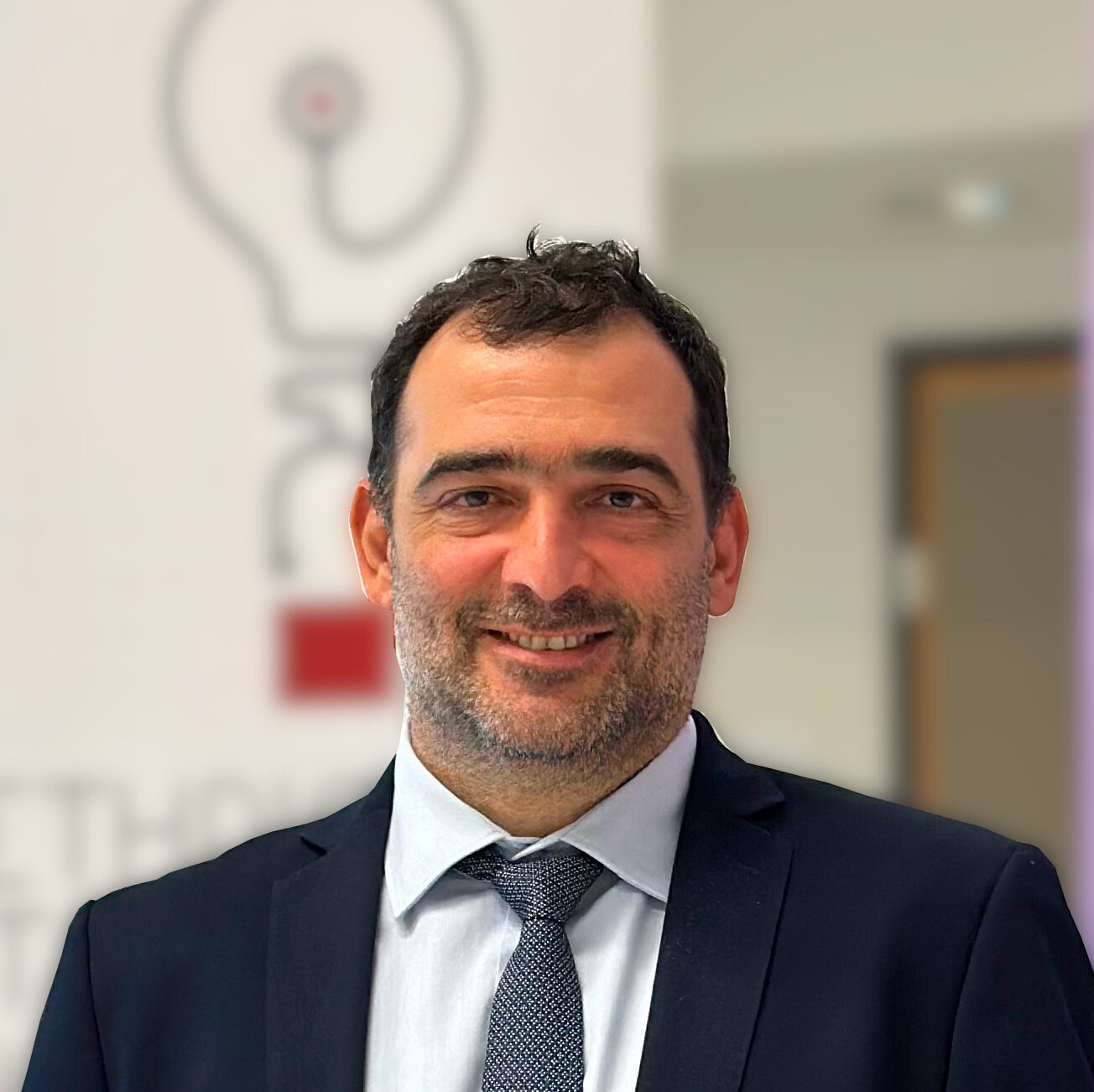
Evdokimos Konstantinidis
Assistant Professor, Lab of Medical Physics and Digital Innovation at Aristotle University of Thessaloniki
Evdokimos Konstantinidis
Assistant Professor, Lab of Medical Physics and Digital Innovation at Aristotle University of ThessalonikiEvdokimos Konstantinidis is an Assistant Professor in Digital, Technological and Open Innovation in Health at the Lab of Medical Physics and Digital Innovation in the Aristotle University of Thessaloniki. He is Vice-Chair of the European Network of Living Labs (ENoLL) and served as Chair from 2021 to 2024. He is coordinator of the ENoLL Health and Wellbeing Living Labs Working Group and his research interests lie predominately in Living Lab methodologies combined with agile aspects in the Health and Wellbeing domain, Open Science and Data Management as well as technological interventions in the field of healthcare. He is currently coordinating Horizon Europe projects on services for the European Open Science Cloud and on innovation experimentation frameworks through Living Labs. He has successfully coordinated the VITALISE project, aiming to harmonize the procedures and ICT tools of the Health and Wellbeing Living Labs, towards creating an open ecosystem for the European researchers.
Alexandra Petcu
Innovation Manager at Advanced Environmental Research Institute, West University of Timișoara, host of the UVT Digital & Green Living Lab
Alexandra Petcu
Innovation Manager at Advanced Environmental Research Institute, West University of Timișoara, host of the UVT Digital & Green Living LabAlexandra Petcu is the coordinator of the UVT Digital & Green Living Lab and head of Innovation & Technology Transfer at the West University of Timișoara (WUT/UVT). She also serves as a visiting lecturer at the Faculty of Economics and Business Administration and the Faculty of Physics at WUT. With previous experience in the Education Ministry during the Romanian Secretariat of the Bologna Follow-Up Group, Alexandra has contributed to policy recommendations in education, innovation, and entrepreneurship. She has led the development of a sustainability-driven student entrepreneurial ecosystem in Western Romania, resulting in the launch of new businesses focused on low CO2 emissions, biodiversity conservation, waste reduction, and digital innovation; since then, she is co-facilitator of the regional entrepreneurship & innovation ecosystem in the West region of Romania. In her current role, Alexandra coordinates the innovation and sustainability strategy for the UNITA – Universitas Montium European University Alliance at WUT. Her research centers on Living Lab methodologies in schools and universities, supporting the EU’s research and education goals for the twin transition.
Ewelina Czujko – Moszyk
Project Manager, PCSS – Poznań Supercomputing and Networking Center
Ewelina Czujko – Moszyk
Project Manager, PCSS – Poznań Supercomputing and Networking CenterEwelina Czujko - Moszyk works in a research center – PSNC Future Labs – located in Poznań, Poland. As a Project Manager, she coordinates diverse projects in such areas as energy & environment, health and education. Being a Living Lab methodology enthusiast, she has been successfully spreading Living Lab ideas, tolls and methods locally in municipalities, hospitals, clinics and libraries. She strives to engage in social projects which change lives and contribute to protecting our planet.
From consultation to co-Creation: A rural Living Lab model for community revitalization in demographically declining municipalities
Abstract:
Rural communities in the Republic of Korea face a compound demographic crisis — population ageing, youth outmigration, and eroding civic capacity — that conventional top-down revitalization programs have repeatedly failed to resolve. This paper presents the Sangju Resident-Led Village Living Lab, organized by Sangju City and operated by Garam & Saram Co., Ltd. between March 2024 and November 2025, as a reproducible model for community-led rural revitalization.
Drawing on 21 months of field data (March 2024 – November 2025), the study examines how a structured Living Lab methodology was adapted to the institutional, cultural, and demographic conditions of a Korean rural municipality. The initiative operationalized a Three-Phase Developmental Model — Trust Building, Community Activation, and Knowledge Anchoring — guided by a “Facilitator-as-Bridge” framework linking resident agency, local government, and innovation networks. Participatory co-design sessions improved resident-reported civic efficacy, intergenerational dialogue, and municipal uptake of community proposals. From these findings the study distils seven design principles for rural Living Labs in low-density, resource-limited settings. Comparative analysis with European frameworks (SIMRA, LEADER) identifies structural convergences and the context-specific adaptations required for East Asian implementation.
Choong-Jae Im
Director, Center for Immersive Media, Keimyung University
Choong-Jae Im
Director, Center for Immersive Media, Keimyung University
Since the first semester of 2023, Choong-Jae has taught the "Global Living Lab Project" course every semester. His work centers on applying the Living Lab methodology to real-world innovation challenges, currently leading two R&D projects funded by the Korean government that aim to address pressing social problems.
At the Center for Immersive Media, Choong-Jae oversees 15 Living Lab-based industry-university-government collaboration projects, reflecting a strong commitment to bridging academic research with practical, community-driven innovation.
His publication record includes Community Innovation and Living Lab (2021, Seoul Institute), a contribution that further establishes his expertise in the field.